Star Trek Fleet Command review 2026: is it worth playing?
A current 2026 assessment of Star Trek Fleet Command's fleet progression, alliance play, PC support and long-term time commitment.
EReview byEthanPublishedReading time7 minAs of official live-game and Update 94 sources checked August 31, 2026
Research-based assessment using the sources listed below. This is not a hands-on test and carries no numeric score. Our review method.
Verdict
Worth trying for Star Trek fans who enjoy long-term fleet building, daily planning and alliance coordination; a poor fit for players who want a short, self-contained strategy campaign or frictionless progress.
The short answer:Star Trek Fleet Command is worth trying in 2026 if you want a persistent Star Trek strategy game built around fleet growth, resource planning and alliance activity. Scopely's official game page outlines the connected station, research, ship and officer systems. That same structure is also its biggest cost: progress is layered, timer-driven and easier with regular check-ins than with occasional standalone sessions.
This documentary assessment uses the official feature set and support documentation checked on August 30, 2026. Device-specific performance and a complete spending analysis remain outside those sources; the documented progression systems establish the commitment and player profile evaluated below.
What kind of game is Star Trek Fleet Command?
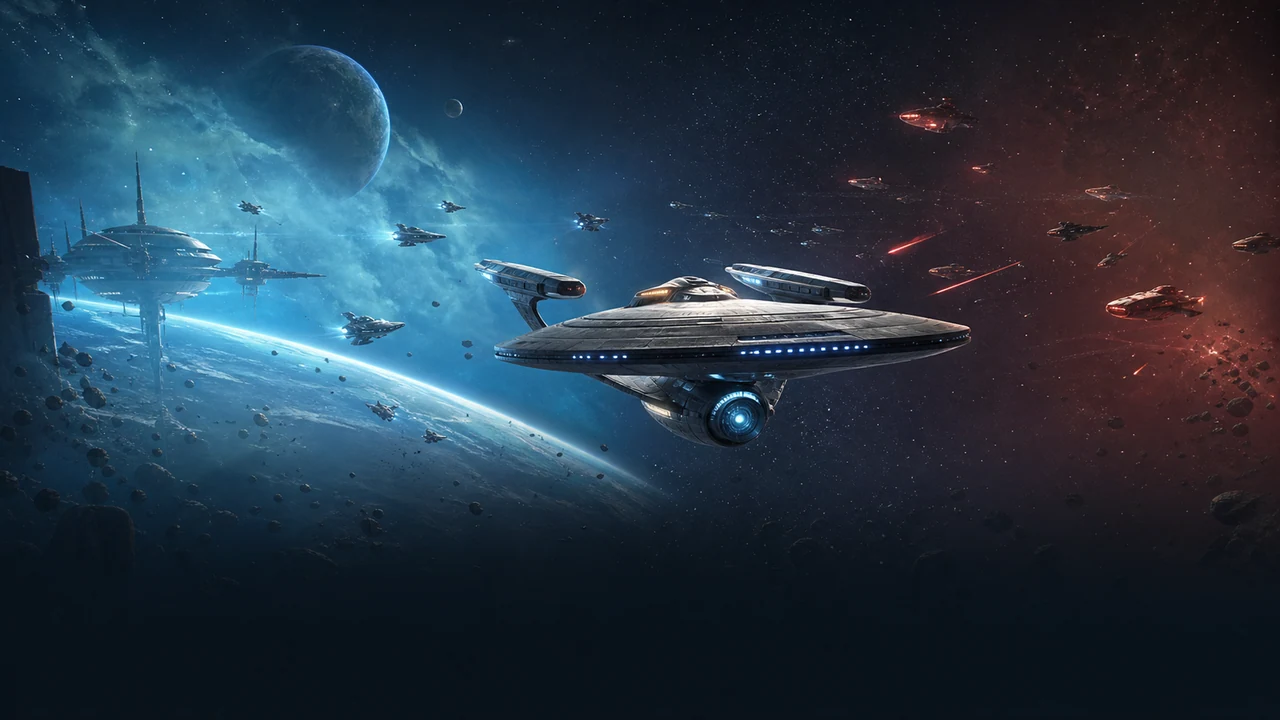
Star Trek Fleet Command is a persistent multiplayer strategy game where you build a station, research upgrades, collect and improve ships, recruit officers, complete missions, mine resources and interact with alliances. The systems open gradually, but they remain connected: a station upgrade can unlock research, research can strengthen a ship, and an officer crew can change how efficiently that ship handles a task.
The galaxy is not a sequence of isolated campaign maps. Other players and alliances share it, and activities range from regular hostile combat to mining, faction progression, PvP and coordinated Armadas. Scopely's current G7 support material extends through Operations levels 71–80, evidence that the game is designed as a long-running service rather than a short campaign.
That scale creates genuine planning depth. It also means a newcomer sees many currencies, timers and upgrade markers before understanding which ones matter.
What does STFC do well in 2026?
Its best quality is purposeful specialization. Combat ships have different classes, survey ships gather resources, officers change according to the target, and alliance coordination matters in group activities. A good session is not only “increase power”; it is deciding what the next unlock requires and assigning the fleet accordingly.
The official Alliance Help documentation gives the social layer practical value by reducing eligible construction, research and repair timers when members respond. Armadas go further by asking players to coordinate ships and debuffs against PvE targets. These features make an active alliance part of normal progression rather than a decorative chat room.
Cross-platform access is another clear strength. Scopely offers native Windows and macOS clients alongside mobile play, with a Scopely Account used to carry the save. Our PC and Mac setup guide covers that transfer safely.
Is the progression satisfying or too grindy?
It can be both. The satisfying part is that a planned upgrade solves a visible problem: more warp range opens a route, a refinery batch supplies a component, a crew change reduces repairs, or an Operations level unlocks a new system. Several small loops feed one larger account plan.
The grind appears when those loops become recurring obligations. Mining, refining, Daily Goals, repairs, building, research and event windows can all compete for attention. Players who enjoy optimizing a persistent account may see this as structure. Players who want a complete tactical experience in one sitting may see it as friction.
The healthiest way to start is narrow: one main mission route, one combat ship and crew, one survey role and a few daily goals that overlap with what you already need. Our beginner guide turns that into a first-hours checklist.
How important are officers, ships and combat choices?
Very important, but not in the form of one permanent “best team.” The captain, bridge abilities, ship class, research and target all affect the result. Regular hostiles, player ships, mining and Armadas reward different setups.
That gives the roster real strategic value. It also adds homework: an officer with high displayed power may be wrong for the activity if the ability condition never triggers. Battle logs and the official activity-specific crew lists are more useful than a static tier list copied without context.
Our crew and officer guide starts with current early PvE and PvP combinations, then explains how to evaluate future officers. For gathering, the ships and mining guide connects survey ships, protected cargo and the refinery.
Can you enjoy Star Trek Fleet Command as a solo player?
You can complete missions, build the station, fight hostiles and mine independently, but a purely solo approach leaves useful systems on the table. Alliance Help reduces eligible timers, group knowledge clarifies server expectations, and Armadas are built around alliance participation.
The better question is whether you enjoy light coordination. You do not need to make the game a second job, but joining an active beginner-friendly alliance improves both efficiency and understanding. Look for clear rules, helpful members and activity times that match yours. If mandatory schedules and group expectations are a deal-breaker, STFC may feel restrictive later even if the opening missions work well solo.
Is STFC friendly to new players in 2026?
The official help center provides beginner, station, ship, officer and activity guides, and the main missions give a usable route. However, the interface still presents several systems and notifications close together. The game is more approachable when you ignore the urge to clear everything and instead follow a priority loop.
There is also a knowledge gap between starting the game and understanding a mature live-service economy. Current guides need dates because new grades, ships, enemies and officer interactions can change the late-game picture. Beginner fundamentals—focused spending, matching crews to activities and protecting exposed cargo—remain more durable than a giant list of supposedly universal endgame rankings.
How should live updates change a beginner plan?
They should change priorities only when they solve a current constraint. Update 94 adds officers, artifacts, progression choices and quality-of-life changes, but a new account does not need to pursue every system simply because it is current. The durable beginner questions remain the same: does the next upgrade improve warp access, a core combat crew, protected cargo or an alliance goal?
Read official patch notes for eligibility and interaction changes before committing resources. Then translate the update into one practical action, such as saving a currency, testing an officer in the correct activity or delaying an upgrade whose requirements changed. This protects the account from guide churn and prevents a late-game announcement from distracting from early fundamentals.
A mature live service will always advertise the newest layer most prominently. Beginners should measure value by what becomes easier this week, not by how close the account appears to content designed for years of progression.
Who should play Star Trek Fleet Command?
Try it if you like Star Trek, incremental account growth, fleet optimization, resource planning and cooperative goals. It is especially suitable if you enjoy checking a persistent game regularly and making small decisions that accumulate into long-term progress.
Skip it, or at least approach cautiously, if you want a finite single-player campaign, instant access to every system, purely tactical battles without economy management, or progress that does not depend on timers and repeatable resource loops. The official PC client makes sessions more convenient, but it does not change that underlying structure.
Is Star Trek Fleet Command worth starting now?
Yes for the right player. The game still has an extended live progression path, official cross-platform clients and active alliance-centered systems in 2026. The Update 94 patch notes add more progression choices, officers, artifacts and quality-of-life changes, showing that the service is still expanding. Starting later means there is more to learn, not that the beginner route has disappeared.
Give it a focused trial rather than trying to evaluate every system at once. Complete the tutorial and early missions, join a helpful alliance, build one coherent crew and run one purposeful mining loop. If that rhythm feels satisfying, STFC has substantial long-term depth. If the timers and repeated check-ins already feel like chores, the later progression is unlikely to reverse that impression.
Frequently asked questions
Is Star Trek Fleet Command free to play?
Yes. The client and core progression are free, with offers, passes and resource purchases providing acceleration and additional options.
Can STFC be played on PC and Mac?
Yes. Scopely provides native desktop clients alongside mobile play. Use the same supported Scopely Account route before assuming progress will transfer automatically.
Do I need an alliance?
Not for early missions, but alliances reduce eligible timers, explain server culture and enable group activities such as Armadas. Long-term solo play leaves important systems unused.
Is Star Trek Fleet Command a tactical ship simulator?
No. Crew, ship, research and target selection matter, but combat sits inside a persistent management and progression game rather than direct bridge control.
Is STFC pay to win?
Spending can compress timers and broaden progression options, particularly in competitive or late-game contexts. Alliance coordination and correct crews still matter, but power is not separated from budget.
Free to play. Standard data rates and in-app purchases apply.
Review strengths and limitations
Pros
Several connected progression layers across station, research, ships and officers
Meaningful alliance help and coordinated Armada activities
Official native clients for mobile, Windows and macOS
An actively extended live-game progression path
Cons
Many overlapping systems create a steep onboarding curve
Timers and recurring resource loops reward frequent check-ins
Long-term progression can feel grind-heavy
PvP exposure and server expectations may not suit solo-focused players