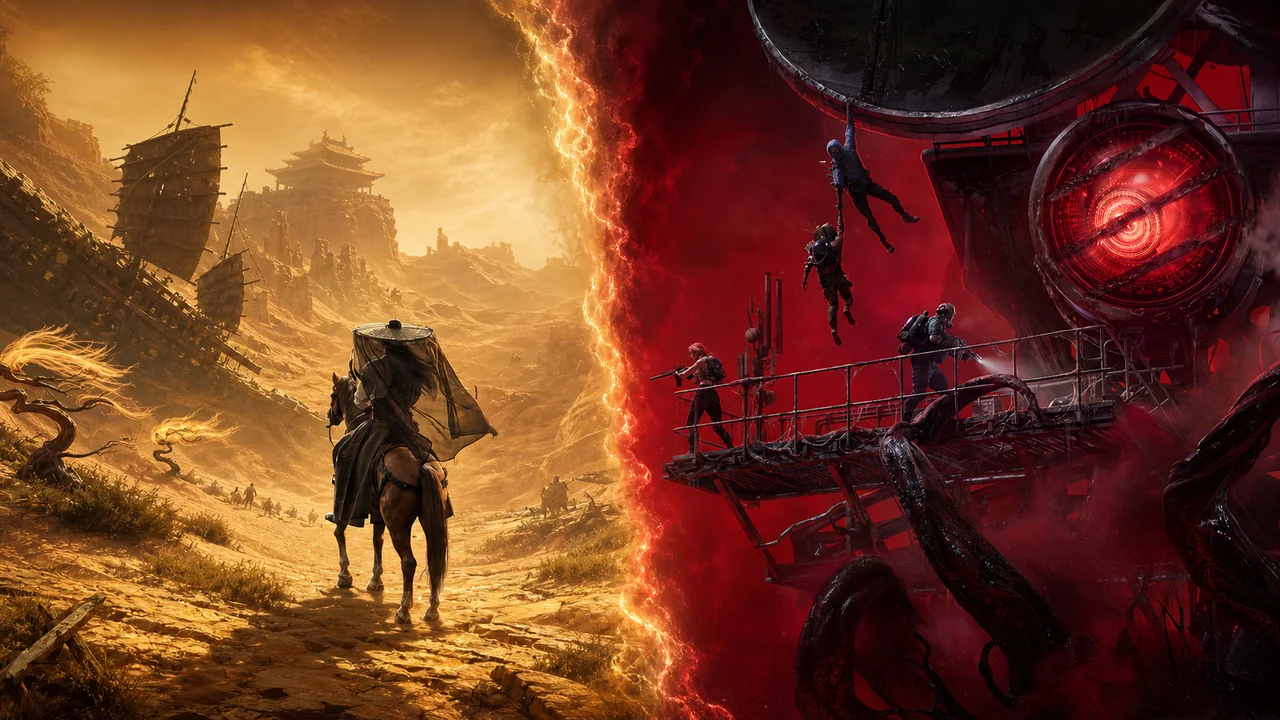
Two ambitious free open worlds from very different traditions: a wuxia action RPG built for exploration, and a survival sandbox built around scenarios, crafting and rebuilding.
By Ethan12 min readAs of official global launch, expansion, scenario and console sources checked August 31, 2026
The short answer: choose Where Winds Meet if you want a free open-world action RPG with authored quests, martial-arts combat and a journey that works well as a solo experience. Choose Once Human if gathering, crafting a territory and solving survival problems with friends sound more important than a continuous story. Both support solo and multiplayer play, but only Once Human makes rebuilding within different scenario rules a central part of the long-term structure.
This comparison uses current publisher announcements and rules pages checked on August 31, 2026, plus the documented findings in our individual reviews. Device performance, complete in-game shop inventories and every platform account-linking path remain outside those sources.
Become a wandering martial artist in 10th-century China
Survive a supernatural catastrophe and build a territory
You want wuxia adventure, or survival planning
Primary loop
Explore, quest, fight and learn martial arts
Gather, craft, build, fight and prepare for scenario goals
WWM for authored adventure; Once Human for systems
World structure
A growing seamless world expanded with new regions
Multiple scenarios with distinct rules, maps and phases
You prefer continuity, or structured fresh starts
Combat focus
Weapon styles, Mystic Arts and action-RPG encounters
Guns, gear builds, Deviations and survival preparation
WWM for melee expression; Once Human for loadouts
Building
Not the central progression loop
Territory construction, facilities and saved house blueprints
Once Human by a wide margin
Solo play
A major supported route through the story and world
Supported, but gathering and upkeep place more work on one player
WWM for solo-first play
Co-op and PvP
Solo, co-op and PvP adventures
PvE and PvP scenarios with cross-platform teaming
Tie, with very different purposes
Platforms checked
PC, PS5, mobile, Xbox Series X|S, Xbox on PC and Xbox Cloud
PC, mobile, PS5/PS5 Pro and Xbox Series X|S
Check the official route for your device
Monetization claim
Publisher promises no pay-to-win mechanics
Publisher says paid features do not affect gameplay or fairness
Treat both as publisher claims, not independent audits
The last row needs context. An official “not pay-to-win” promise is useful evidence of intent, but it does not measure shop pressure, battle-pass design or the time a live service asks from a regular player. We therefore compare what each game asks you to maintain, not just what each publisher calls its store.
How we compared them
We used six criteria: quality of the solo route, co-op dependence, world continuity, combat identity, maintenance burden and monetization risk. We checked Where Winds Meet's global launch, Hexi and Xbox announcements, then compared them with Once Human's August 2026 console FAQ and its documented scenario rules.
Our use of maintenance burden covers recurring work that keeps an account ready to play: gathering resources, rebuilding facilities, checking scenario phases and managing equipment. It is not a measurement of hours played. The comparison also avoids player-count and revenue estimates because no independently verified current figure is required to answer which design fits a reader.
What is the biggest difference between these open worlds?
Where Winds Meet treats its world as a place to cross. Once Human treats its world as a problem to organize.
In Where Winds Meet, movement, combat and discovery feed an authored martial-arts journey. The official global launch material describes a 10th-century setting, multiple weapon families and Mystic Arts, with solo play, co-op for up to five players in a group and separate PvP possibilities. Later free expansions added large regions rather than replacing the basic identity of the journey. Hexi brought deserts, snowfields and grasslands; the Xbox announcement framed Hidden Mountain as another vertically layered exploration region.
Once Human begins with familiar survival verbs: gather, craft, build, explore and fight. Its distinctive layer is the scenario. The publisher defines a scenario as the gameplay theme of a server, with its own objectives, rules, phases and sometimes a different map. One may emphasize PvE and harsh environments, another factions or PvP. Progress is therefore divided between account-level things that carry forward and scenario-level development that may be rebuilt or transferred under specific rules.
That difference should decide the comparison before graphics or combat do. If a new region feels like an invitation to continue one journey, Where Winds Meet fits. If a new ruleset feels like a reason to redesign a base and build another team plan, Once Human fits.
Which game has better combat?
Where Winds Meet has the clearer combat identity. Its weapons and Mystic Arts are the main expression of the character: swords, spears, dual blades, fans, umbrellas and other styles change reach, rhythm and defensive options. The official material also places acrobatic martial techniques beside conventional attacks, so exploration fantasy and combat language reinforce one another.
Once Human's combat is broader but more dependent on preparation. Guns, armor, mods, consumables and Deviations sit inside a survival economy. A difficult encounter can expose a weak build, but it can also reveal that a group did not bring enough ammunition or the right utility. Shooting is part of the loop rather than the whole product.
Pick Where Winds Meet when learning a moveset and responding inside a fight sound satisfying. Pick Once Human when planning the kit, building the production chain and dividing roles before the fight are equally important. Neither conclusion requires claiming that one has objectively better hit detection or balance; those would require controlled hands-on testing across current versions.
How do progression and resets compare?
Where Winds Meet is easier to understand as a continuing RPG account. Expansions add regions, stories, bosses and martial arts to the existing game. Live-service events and currencies still create menus and schedules, but the central promise is that the wanderer's journey grows outward.
Once Human deliberately asks players to understand what persists. Its official scenario documentation says names, cosmetics, important currencies, blueprints, formulas and several account resources can carry across scenarios, while character levels, Memetics and some scenario-specific items follow reset or transfer rules. Crafted gear and regular materials can move to Eternaland, and a later scenario limits what can be brought back through Resource Inheritance Points.
Calling that a total wipe is inaccurate. Calling it fully permanent is equally misleading. The practical experience is a partial rebuild: meaningful knowledge and account unlocks remain, but a new scenario can ask you to level, gather and construct again. That is refreshing for players who enjoy clean strategic problems and frustrating for players who want one untouched home.
Where Winds Meet is the safer solo recommendation. Its setting, narrative exploration and combat progression do not require a permanent group to make sense. Co-op is available when a boss or shared adventure benefits from company, but the fantasy remains that of one wandering martial artist.
Once Human can be played alone, including in PvE scenarios, yet its work divides naturally across a group. One person can gather, another improve the territory and another prepare combat routes. A solo player performs every role and feels the repetition more sharply. For a regular group, the shared territory gives cooperation a practical purpose that Where Winds Meet's lighter co-op does not try to reproduce.
PvP should not be treated as one interchangeable checkbox. Where Winds Meet offers PvP alongside a large solo/co-op RPG. Once Human separates different experiences through PvE and PvP scenario choices. Choose the structure, server and rules you actually want before investing time.
Can you play both on PC, console and mobile?
Yes on PC and current consoles, with different routes.
Where Winds Meet launched globally on Steam, Epic Games Store, the official PC client and PlayStation 5 with cross-play and cross-progression support. Official 2026 material also records mobile availability and a June launch on Xbox Series X|S, Xbox on PC and Xbox Cloud. Because account linking can depend on the storefront, use the publisher's current instructions before creating a second login.
Once Human's August 2026 console FAQ lists PC, mobile, PlayStation 5/PS5 Pro and Xbox Series X|S. Its official launch notice confirms the August 25 release and account-linking route, so friends can team across supported cross-platform servers. Server, region and scenario selection still matter, and console-exclusive servers are a separate choice.
The correct takeaway is not that every route is frictionless. Both games are live services with accounts, regions and platform identities. Link the account you intend to keep before buying cosmetics or spending dozens of hours, and confirm that friends have chosen compatible servers and scenarios.
Which free-to-play model is safer?
On the official record, both publishers say competitive power is not sold. Where Winds Meet's launch announcement promises no pay-to-win mechanics. Once Human's console FAQ says paid features cover cosmetics, a Battle Pass and other content that does not affect gameplay or fairness.
Those are publisher statements, so this comparison does not convert them into a guarantee. A shop can remain cosmetic and still use limited-time offers, layered currencies or frequent prompts. A live service can also change after publication.
The more visible difference today is the cost paid in time. Where Winds Meet can overwhelm with activities and progression tracks, but an absent player does not first have to enjoy a base-maintenance loop. Once Human turns resource preparation and scenario phases into part of the game. For the right group that is the appeal; for the wrong player it feels like a schedule.
Spend only after the free loop has already proved enjoyable. Cosmetics should be treated as entertainment attached to the current game, not an investment in permanent account value.
Who should pick which?
If you…
Pick
Why
Want an authored solo adventure
Where Winds Meet
Story, exploration and martial-arts progression remain central
Want expressive melee combat
Where Winds Meet
Weapons and Mystic Arts define moment-to-moment play
Want to build a functional base
Once Human
Territory facilities and saved house blueprints are core systems
Have a regular co-op group
Once Human
Gathering, building and encounter preparation divide naturally
Dislike partial seasonal rebuilding
Where Winds Meet
Its expansion model is easier to read as one continuing journey
Enjoy fresh rule sets and new starts
Once Human
Scenarios deliberately change goals, phases and sometimes maps
Want a competitive game with no live-service pressure
Neither
Both use ongoing content, accounts and recurring engagement systems
Only want a traditional shooter
Neither
One is a wuxia ARPG; the other wraps gunplay in survival systems
What we did not compare
We did not rank current endgame damage builds, server populations or frame rates. Those claims require repeatable tests on equivalent hardware and current accounts. We also did not assign a universal value to either Battle Pass or shop because offers can vary by platform and date.
Finally, we did not treat publisher player-count announcements as proof of current active population. Installation, registration and monthly activity are different measurements, and none changes the underlying fit decision.
Frequently asked questions
Is Where Winds Meet more solo-friendly than Once Human?
Yes. Where Winds Meet supports co-op and PvP, but its authored world and martial-arts journey work naturally around one character. Once Human supports solo play, yet gathering, building and preparation create more work when no group shares those roles.
Does Once Human delete everything at the end of a scenario?
No. Official rules preserve many account resources, cosmetics, currencies, blueprints and formulas, while other development resets or moves through Eternaland and inheritance rules. Expect a partial rebuild, not a completely empty account and not a fully unchanged world.
Can Where Winds Meet and Once Human be played across platforms?
Both have official cross-platform support, but the available devices and account-linking routes differ. Check the current publisher instructions, link the account you intend to keep and make sure friends select compatible servers or scenarios.
Are either of these games pay-to-win?
Both publishers say no: Where Winds Meet promises no pay-to-win mechanics, and Once Human says paid features do not affect gameplay or fairness. Those are official claims rather than independent shop audits, so review current offers before spending.
Which game is better for a group of three or four friends?
Once Human is the stronger long-term group game if everyone likes survival work, because building, gathering and combat preparation create persistent shared jobs. Where Winds Meet is better when the group wants to meet for selected bosses or adventures without maintaining a shared base.
The verdict
Pick Where Winds Meet if your ideal free open world is a beautiful place to travel through, with martial-arts styles to learn and an authored adventure that remains satisfying alone. It asks you to navigate a broad live-service RPG, but its central fantasy is clear and its expansions extend that journey.
Pick Once Human if your group enjoys turning a dangerous map into a functioning home, then adapting that plan to a new scenario. Its survival, building and Deviations create a stronger cooperative project than Where Winds Meet, provided partial rebuilding sounds motivating rather than wasteful.
For most solo-first players, Where Winds Meet wins. For an organized survival group, Once Human wins just as clearly. The choice is not really between two free open worlds; it is between inhabiting a martial-arts journey and maintaining a shared survival system.
Free to play. Standard data rates and in-app purchases apply.
Two alliance-driven 4X games, one built around a seamless land war and one around a customizable pirate flagship. Here is which one fits which player in 2026.
Two free-to-play open-world character RPGs, but one builds its identity around a supernatural city while the other prioritizes elemental wilderness exploration.
Aug 31, 202610 min read
YOUR PRIVACY
Choose how GameSelecto measures visits
Necessary storage keeps your choice. Analytics helps us improve articles; advertising measures campaigns. Optional tracking stays off unless you allow it.Cookie details.
COOKIE SETTINGS
Control optional tracking
Necessary storage is always on so the site can remember this choice.