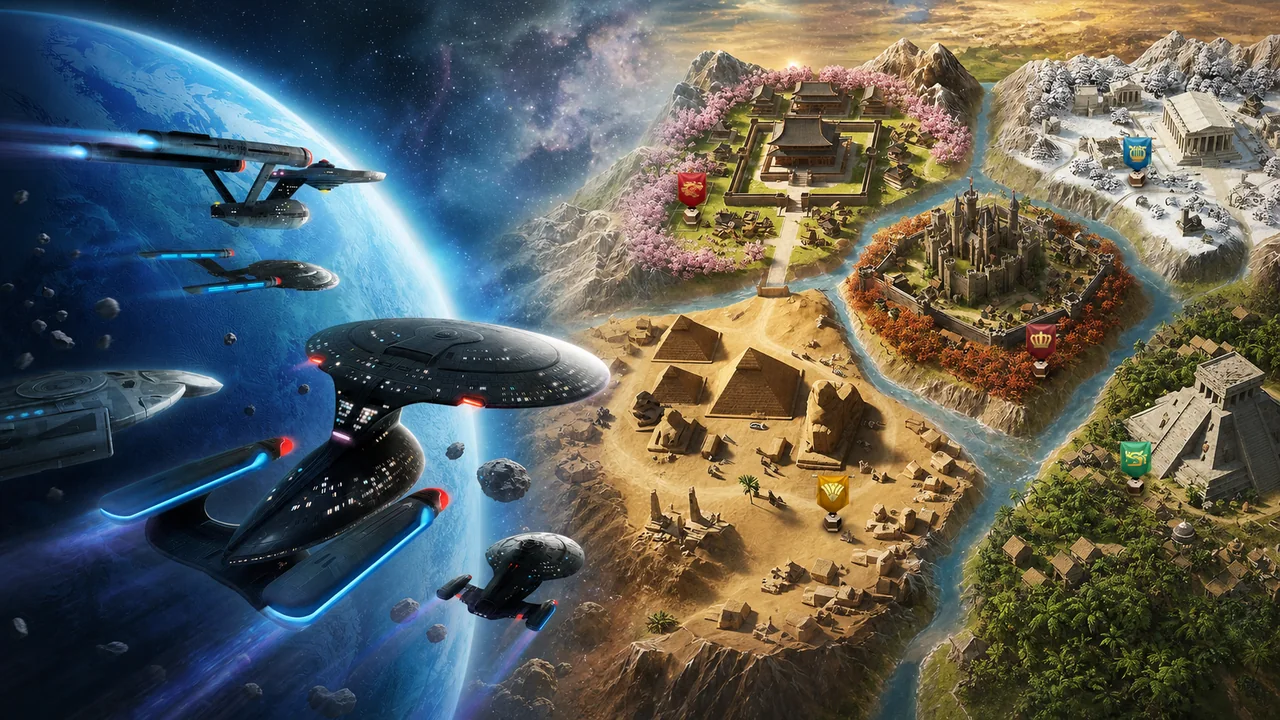
The short answer: choose Rise of Kingdoms if you want armies moving across one readable world map, terrain that gates access and alliance wars built around rallies, reinforcements and strategic passes. Choose Sea of Conquest if the fantasy matters more: your base is a pirate flagship, your roster is a crew of heroes, and sailing for treasure or fighting sea monsters is more appealing than developing a historical city. Both are persistent free-to-play 4X games. Neither offers a fair competitive reset between a new account and an established spender.
This comparison uses Lilith Games, FunPlus, the two official game sites and current Apple and Google storefront records checked on August 31, 2026. Top-server balance, controlled spending outcomes and publisher player or revenue data remain outside those sources.
Rise of Kingdoms vs Sea of Conquest at a glance
|
Rise of Kingdoms |
Sea of Conquest |
Better for you if… |
| Core fantasy |
Build one of 15 historical civilizations |
Command and customize a fantasy pirate flagship |
You prefer history or pirates |
| Genre on record |
Real-time civilization strategy / 4X |
Pirate strategy / 4X with RPG heroes |
You want map tactics or character-driven fleet building |
| Home base |
A city inside a seamless kingdom map |
A flagship with cabins, armaments and a figurehead |
Sea of Conquest for a more distinctive base |
| World activity |
Scouts, gathering, forts, rallies and kingdom war |
Ports, treasure, rival pirates, navy forces and sea monsters |
Sea of Conquest for naval variety |
| Collection layer |
Commanders, sculptures, talents and troops |
Heroes, ships, cabins and fleet formations |
Tie — both are roster-heavy |
| Large-group structure |
Alliances and kingdom objectives |
Gangs, port conflict and shared rewards |
Tie — group fit matters more than the label |
| Official platforms visible |
iPhone, iPad, Mac and publisher desktop routes |
iPhone, iPad, Android and a Windows route on the official site |
Check the exact client for your device |
| Store disclosures |
In-app purchases and loot boxes |
In-app purchases; paid-currency and item services disclosed |
Neither is cosmetic-only |
| Current record checked |
Official site and App Store on August 31 |
Google Play updated August 23, 2026 |
Both remain actively distributed |
The platform row needs context. Apple's listing confirms Rise of Kingdoms on iPhone and iPad, with compatibility for Apple-silicon Macs, while its wider desktop route is presented through Lilith's ecosystem. Sea of Conquest's official site displays Android, iOS and Windows download options, but Apple's US listing says the iPad app is not verified for macOS. Use the publisher page for the device you actually own rather than assuming that every mobile build runs on every desktop.
The store-disclosure row also does not prove which game costs less. A storefront can show selected purchase examples, while the real competitive cost depends on event cadence, server age, alliance expectations and the rank a player is trying to hold.
How we compared them
We used six criteria that can be checked without pretending to own two mature accounts: map and combat design, collection depth, onboarding, official platform support, dependence on a group and monetization pressure. Publisher pages establish what each game currently promises; storefront disclosures establish supported devices, age guidance and the presence of in-app purchases or randomized acquisition. Our individual reviews inform the fit assessment.
In this article, pay-to-win pressure means that spending can materially accelerate construction, research, hero or commander development, recovery, or access to competitive options. It does not mean a free account has no useful role. It also does not mean every purchase guarantees a win: alliance coordination and account planning still matter in both games.
What is the biggest gameplay difference?
Rise of Kingdoms makes the map the center of the strategy. Its official App Store description is unusually specific: battles occur in real time on the shared map, players can enter or leave an engagement, and rivers, mountains and passes restrict movement. Marches are visible decisions. Reinforcing an ally, contesting a pass and repositioning before a rally all make geography part of the conflict.
Sea of Conquest makes the flagship the center. FunPlus describes renovating pirate cabins, customizing armaments and a figurehead, forming a crew and sailing into battles against other pirates, navy forces and sea monsters. The world still contains ports and group conflict, but progression is presented through the vessel and its people rather than through a civilization spreading over land.
That creates a simple choice. Rise of Kingdoms is easier to read as a war game: the question is where armies are, what terrain blocks them and when an alliance commits. Sea of Conquest is easier to inhabit as an adventure fantasy: the ship is both a moving home and a visible record of progress.
Neither approach removes pre-battle account power. Rise of Kingdoms fights are shaped by commander investment, troop tier, technology and alliance strength. Sea of Conquest fights are shaped by heroes, ship development, cabins and fleet composition. Good decisions help, but they do not erase a large progression gap.
Which has the better progression and collection loop?
Rise of Kingdoms has the cleaner strategic hierarchy. A civilization provides architecture, a special unit and bonuses; commanders provide active skills and talent paths; troops and research translate those choices into marches. The danger is dilution. Spreading scarce commander materials across too many unfinished characters produces a broad roster with little battlefield authority.
Sea of Conquest has the more theatrical loop. Upgrading a cabin or changing a flagship component feels attached to the object you sail, while heroes give the crew recognizable faces. Treasure hunts, ports and monsters also create reasons to move that are easier to understand than another abstract resource node. Its danger is multiplication: heroes, ships, rooms, equipment and event rewards can become several upgrade ladders competing for the same attention.
For a new player, the best rule is the same in both games: build one functional core before chasing every new unlock. In Rise of Kingdoms, that means a focused commander pair and troop plan. In Sea of Conquest, it means a coherent primary fleet rather than every attractive pirate upgraded halfway.
Our full Rise of Kingdoms review examines the commander and kingdom loop. Our Sea of Conquest review covers the flagship, heroes and alliance race in more detail.
Which is better on PC and mobile?
Both can move beyond a phone, but the official routes are not identical.
Rise of Kingdoms is explicitly listed for iPhone and iPad, and Apple's compatibility record supports Macs with an M1 chip or later. Lilith also maintains its official game site and desktop distribution. That makes it the safer choice for someone who expects to alternate between mobile and a Mac, provided the same account and kingdom are selected.
Sea of Conquest's official page displays Google Play, App Store, Android and Windows options. Its Apple listing is designed for iPad and explicitly says it is not verified for macOS. A Windows player therefore has a publisher route, while a Mac player should not infer support from the iPad badge.
Desktop play improves information density in both games: more of the map, queues and upgrade panels fit on screen. It does not change the underlying economy into a conventional premium PC strategy game. Timers, recurring events, alliance schedules and account power travel with the account.
Whichever game you install, use the publisher or storefront link, bind the account before spending, and verify the correct server or kingdom before assuming progress has disappeared. Do not install a third-party emulator merely because an advertisement uses the phrase “play on PC” when an official route is available.
Which one is more free-to-play friendly?
There is no responsible way to declare either game fair from storefront prices alone.
Apple marks Rise of Kingdoms as free with in-app purchases and discloses loot boxes. Its visible purchase examples range from small daily offers to larger packages, but that list is a sample, not a cap. Progress is accumulated through builders, research, commanders, troops, resources and recovery; spending can compress several of those limits.
Sea of Conquest is also free with in-app purchases. Its own official site promotes a top-up store, first top-up rewards and cumulative top-up rewards, which is clearer evidence of a progression economy than any marketing promise about adventure. Hero and fleet layers mean paid acceleration or randomized acquisition can widen options over time.
For a relaxed player, Sea of Conquest can feel less like a spreadsheet because treasure, sailing and the flagship disguise the familiar 4X scaffolding. That is presentation, not proof of softer monetization. For a disciplined strategist, Rise of Kingdoms can remain satisfying without chasing leaderboard parity because a focused account can fill rallies, gather and support objectives. That is usefulness, not equality.
Set a fixed budget before joining a competitive alliance. Do not spend to repair a planning mistake or match the strongest account on a young server. Both games can always create another timer, hero or event milestone after the current one.
Which is better for solo and social players?
Neither is designed around long-term solo independence.
Rise of Kingdoms alliances provide reinforcement, rally capacity, territory, shared rewards and protection. A player outside a functional alliance loses more than chat: the strategic map becomes harder to survive and much less interesting. Kingdom wars also turn time-zone coverage and leadership into real advantages.
Sea of Conquest calls its groups gangs. FunPlus explicitly presents collaboration, conquest and shared spoils as core features. The pirate theme can make informal cooperation feel friendlier, but scheduled group goals and server politics still follow. A good gang converts routine upgrading into a shared voyage; a mismatched one converts a game into an attendance sheet.
Choose the community before the logo. Ask when events happen, whether voice chat is required, how the group handles inactive players and whether it expects purchases. A compatible mid-table alliance is healthier than a top group whose timetable controls your day.
Who should pick which?
| If you… |
Pick |
Why |
| Want terrain and army movement to drive decisions |
Rise of Kingdoms |
Its seamless map, passes and real-time reinforcement are the clearest strategic hooks |
| Want your base to feel like a character |
Sea of Conquest |
The customizable flagship is more distinctive than a conventional city |
| Prefer historical civilizations |
Rise of Kingdoms |
Its 15 civilizations frame units, architecture and bonuses |
| Prefer pirates, monsters and treasure |
Sea of Conquest |
The entire progression loop serves that fantasy |
| Want a verified Apple-silicon Mac route |
Rise of Kingdoms |
Apple lists Mac compatibility; Sea of Conquest is not verified for macOS |
| Want a focused Windows pirate game |
Sea of Conquest |
Its official site exposes a Windows download route |
| Want fair-start competitive PvP |
Neither |
Persistent progression and purchases accumulate in both |
| Want to play without a group |
Neither |
Alliances or gangs shape protection, rewards and major objectives |
What we did not compare
We did not rank current server populations, because neither publisher provides a comparable audited figure for active accounts by kingdom. We did not calculate a “cost to compete,” because that changes with server age, event schedule and target rank. We did not score late-game balance from promotional pages. And we did not treat age ratings as financial-safety ratings: content suitability and purchase design are separate questions.
Frequently asked questions
Is Sea of Conquest just Rise of Kingdoms with pirates?
No. They share persistent 4X progression, group conflict and hero or commander collection, but their emphasis differs. Rise of Kingdoms is organized around a seamless terrain map and movable armies; Sea of Conquest turns the flagship, pirate crew and sea activities into the center of the fantasy.
Which game has better combat?
Rise of Kingdoms has the clearer large-scale tactical layer because movement, passes and reinforcement happen visibly on the shared map. Sea of Conquest has the stronger naval presentation and more varied pirate targets. In both, account development constrains what tactics can achieve.
Can I play Rise of Kingdoms and Sea of Conquest on PC?
Both publishers expose desktop routes, including Windows. Rise of Kingdoms also has verified Apple-silicon Mac compatibility through Apple's listing; Sea of Conquest's iPad listing is not verified for macOS. Always use the current official download page for your operating system.
Which game is less pay-to-win?
The available official records do not support a confident winner. Both disclose in-app purchases, both convert long progression ladders into competitive power, and Sea of Conquest's own site advertises top-up rewards. Treat either as pay-to-progress and avoid spending for leaderboard parity.
Do I need an alliance or gang?
Yes for the complete game. You can perform solo tasks in either, but protection, group rewards and the most consequential conflicts depend on an active alliance in Rise of Kingdoms or gang in Sea of Conquest.
The verdict
Pick Rise of Kingdoms if your ideal session starts by opening a strategic map: you want to see an ally under attack, redirect a march, contest a pass and understand why the battle happened where it did. Its historical skin is broad, but its best feature is mechanical clarity.
Pick Sea of Conquest if your ideal session starts on the deck of a ship: you want cabins and armaments to make the base tangible, heroes to feel like a crew, and treasure or sea monsters to break up the alliance war routine. It is the more persuasive fantasy even when the progression underneath is familiar.
For most strategy-first players, Rise of Kingdoms wins because its map turns position into information and gives lower-power alliance members understandable jobs. For pirate fans, Sea of Conquest is the better install because it commits its art, base and activities to the same naval identity. Neither wins on spending fairness, and the group whose schedule fits your life should break a close tie.
If you want to see how Rise of Kingdoms compares with a science-fiction 4X, read Star Trek Fleet Command vs Rise of Kingdoms. If direct sailing and a player-driven naval economy matter more than mobile 4X progression, our World of Sea Battle review is the more useful next step.
Free to play. Standard data rates and in-app purchases apply.