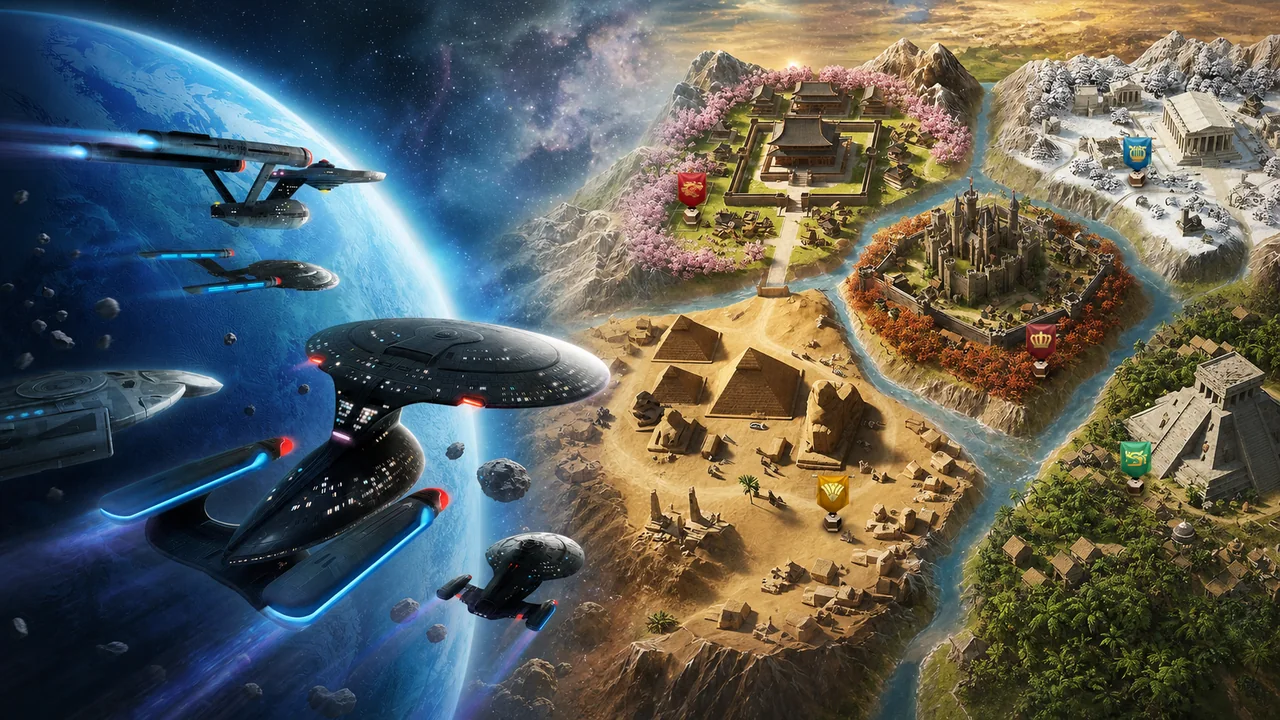
Star Trek Fleet Command vs Rise of Kingdoms in 2026
Two persistent free-to-play 4X games, two very different maps and two very different spending cultures. Here is which one fits which player in 2026.
By Ethan12 min readAs of STFC M94.1 and Rise of Kingdoms 1.1.11.25; storefronts and official sites checked August 31, 2026
The short answer: pick Rise of Kingdoms if you want the map itself to be the strategy — armies march in real time across shared terrain and orders can change mid-move. Pick Star Trek Fleet Command if the Star Trek licence matters to you, or if you want a deep officer-and-ship collection layer sitting on top of the 4X loop. Both are persistent, alliance-driven and slow. Neither is a fair-start match.
This comparison uses both publishers' official sites, Apple's storefront listings and platform records checked on August 31, 2026. Those sources support the documented systems and platform differences below, but not a late-game account test, revenue estimate or player count.
Star Trek Fleet Command vs Rise of Kingdoms at a glance
Star Trek Fleet Command
Rise of Kingdoms
Better for you if…
Core fantasy
Command a Star Trek fleet
Grow a historical civilization
You care about a licence, or you don't
Genre on record
4X, RPG, MMO
Real-time strategy
You want an RPG layer, or a purer map game
The map
Systems and nodes you warp between
One seamless world map
RoK for movement as strategy
Mid-march orders
Not the core loop
Marches can be re-tasked in flight
RoK for reactive play
Collection layer
Officers and ships, deeply intertwined
Commanders and talent trees
STFC for collection depth
Developer / publisher
Digit Game Studios (developer) / Scopely (publisher)
Two rows deserve a caution before you lean on them. Storefronts display a sample of popular in-app purchases rather than a complete price list, so the ranges above show how each game presents spending at the shop window — not a ceiling on what either can cost. And a version number tells you a game is maintained, not that its last patch was good.
How we compared them
We used the same six criteria for both games: map design, collection depth, onboarding, official desktop support, alliance dependence and monetization pressure. Here, spending pressure means that purchases can compress timers, accelerate resources or widen the options available to an account. It does not prove an exact combat advantage in every mode, and this comparison does not attempt to measure a late-game power gap.
This comparison combines our individual reviews with STFC's current M94.1 patch notes, both publishers' platform pages and the two Apple storefront listings checked on August 31, 2026. It is an editorial fit assessment, not a fresh late-game benchmark or a claim that a lower age rating makes a game's purchases safer.
What actually separates these two games?
The map. Everything else is a variation on the same live-service 4X skeleton, but the two games disagree about what a map is for.
Rise of Kingdoms puts every army on one seamless world map, and battles happen there rather than behind a separate combat screen. Marches can receive new orders while they are still moving, so a gathering march can be redirected, an ally can be reinforced mid-attack and several commanders can operate at once. Rivers, mountains and passes give geography real weight: terrain decides who can reach what, and how fast.
That single design choice changes the texture of play. A lower-power account still contributes by filling rallies, holding a pass or gathering efficiently, because where you are is information the other side has to respond to. Movement is a decision, not a loading bar.
Star Trek Fleet Command builds its depth in a different place. Its strength is the way station, research, ships and officers feed one another — an officer unlocks a ship's potential, a research node unlocks the officer, the station gates the research. It reads less like a war map and more like a very large machine you gradually learn to operate. Combat is ship against ship, and the interesting choices happen when you assemble the crew before the fight rather than while the fight is happening.
Neither approach is better in the abstract. But they reward opposite instincts: Rise of Kingdoms rewards reacting, Star Trek Fleet Command rewards preparing.
Which one respects your wallet?
Both monetise the same way — long upgrade paths, timers and resource loops that money compresses — but they present that pressure very differently at the storefront.
The Star Trek Fleet Command App Store listing shows purchase examples from $4.99 to $99.99 and rates the app 13+. The Rise of Kingdoms listing shows examples from $0.99 to $9.99 and carries a 9+ rating. Read those as storefront samples, not spending caps or proof that one game sells less progression over time. They establish transaction examples, not the competitive result of a year's purchases.
Underneath, both games attach value to time and account breadth, while their official stores offer purchases that accelerate progress. A player who stays free should therefore plan around narrower short-term options rather than assume the same progression speed as a paying account; this source review does not quantify the resulting power difference. In Rise of Kingdoms, the sensible free-to-play goal is a focused set of commanders and troops available for group objectives. In Star Trek Fleet Command, the equivalent is accepting layered, timer-driven progression and using regular short check-ins instead of rare long sessions.
Where they genuinely differ is the cost of a mistake. Rise of Kingdoms punishes scattered commander investment: sculptures and experience spread across a half-built roster produce an account weaker than a focused one, and reversing that is slow. Star Trek Fleet Command punishes misreading the machine — pushing station level ahead of research and ships creates a fleet that cannot survive the content its level attracts.
That matters more than it sounds. In this genre most "play on PC" search results lead to third-party emulators rather than the publisher's own client, and an emulator adds a layer that can complicate account linking and support. Both of these games let you skip that entirely.
Two practical rules apply either way. Use the publisher's or storefront's official route rather than a third-party installer, and link the account you intend to keep before investing — verify you are on the right kingdom or server, because progress that looks missing is usually progress sitting on a second account. If you are heading to Star Trek Fleet Command on desktop, our guide to playing STFC on PC or Mac walks through the official route.
A larger screen and a mouse are a real quality-of-life gain in both games — multi-march management in Rise of Kingdoms and crew assembly in Star Trek Fleet Command are both fiddly on a phone. Neither PC client turns its game into a conventional desktop RTS, though. The same persistent account, economy and event schedule follow you across.
Which is friendlier to a new player in 2026?
Rise of Kingdoms, by a clear margin, and for two reasons that have nothing to do with quality.
The first is the onboarding curve. Star Trek Fleet Command's overlapping systems are its long-term strength and its short-term wall — the number of things a new commander must hold in mind before the game opens up is genuinely steep. Rise of Kingdoms front-loads visible progress: buildings finish quickly, scouts reveal the map and commanders arrive often. The complexity arrives later, once you already understand the loop.
The second is the starting choice. Rise of Kingdoms advertises 15 civilizations, and while the starting pick influences early efficiency, the commander roster is the system that actually rewards long-term planning. That is a forgiving structure: an early civilization choice is not a permanent verdict on your account.
Star Trek Fleet Command's compensation is the licence. If the reason you are here is that you want to run a crew with names you recognise from the shows, no amount of design elegance in a historical strategy game replaces that — and pretending otherwise would be dishonest. Our beginner guide to Star Trek Fleet Command exists precisely because the opening hours are where most accounts go wrong.
Both games are worse for solo players than their store pages suggest. Alliance membership is not an optional social feature in either one: it gates protection, rewards, coordinated content and most of the interesting decisions.
Who should pick which
If you…
Pick
Why
Want movement and terrain to be the strategy
Rise of Kingdoms
Seamless map, re-taskable marches, terrain that gates access
Are a Star Trek fan
Star Trek Fleet Command
The licence is the product, and it is used well
Want a deep collection layer
Star Trek Fleet Command
Officers and ships interlock more intricately than commanders alone
Are starting your first 4X
Rise of Kingdoms
Gentler opening, more forgiving early choices
Are setting this up for a younger player
Neither by rating alone
Age ratings describe content suitability, not financial safety; review purchase controls separately
Play in short daily check-ins
Either, cautiously
Both reward frequency; neither rewards absence
Want a fair-start competitive match
Neither
Both are persistent accounts where months and money accumulate
Want to play mainly solo
Neither
Alliances gate protection, rewards and most content in both
What we did not compare
Three things, deliberately. We did not rank late-game power ceilings, because that requires a mature account in each kingdom rather than a reading of official material. We did not compare current event calendars, because both rotate on schedules that would date this page within weeks. And we did not estimate player populations or revenue, because no reliable public figure for either exists that we could verify today.
Frequently asked questions
Is Rise of Kingdoms pay-to-win compared to Star Trek Fleet Command?
The official records are not enough to declare one categorically more pay-to-win. Both games sell progression acceleration: spending can compress timers, widen account options or speed recovery. Rise of Kingdoms surfaces cheaper examples in its App Store listing, while Star Trek Fleet Command lists examples up to $99.99, but those samples do not measure the late-game power bought per dollar.
Can I play both without spending anything?
Yes. Both storefronts list the games as free with optional in-app purchases, and a free account can fill alliance roles through gathering, rallies and group objectives. Expect progression to take longer and keep the roster focused; this comparison does not claim a tested free-versus-paid combat threshold.
Which one has a better PC version?
Star Trek Fleet Command has the broader native desktop support because Scopely offers both Windows and macOS clients. Rise of Kingdoms has an official Windows client; its Mac route is the iPad app running on macOS 11 or later with Apple M1 or newer hardware. Both remain persistent live-service games on desktop rather than becoming conventional standalone PC strategy games.
Which is better for a player with 20 minutes a day?
Rise of Kingdoms handles short sessions slightly better, because gathering and queue management fit into check-ins. But both games schedule their most rewarding content — kingdom wars, armadas — at fixed hours that a 20-minute daily budget will regularly miss.
Do I need an alliance in either game?
Yes, in both. Treat alliance culture as the real decision: pick one whose time zone and activity expectations match your life, in whichever game you choose. A good alliance in the "wrong" game beats a bad alliance in the right one.
The verdict
Pick Rise of Kingdoms if you want the map to be the game — real-time marches, terrain that matters, orders you can change while they are in flight — or if this is your first persistent 4X and you want a gentler opening.
Pick Star Trek Fleet Command if you care about Star Trek, or if the part of these games you actually enjoy is assembling and upgrading a collection of officers and ships rather than moving armies across ground.
For most players starting today, Rise of Kingdoms wins — its seamless map turns movement itself into a strategic decision and its opening hours are more forgiving. Its storefront currently surfaces lower-priced examples, but that is not a spending cap or a promise of fairer long-term competition. The verdict flips entirely for one group, and it is a large one: if you came here because you want to command a Star Trek fleet, Star Trek Fleet Command is not a compromise. It is the only one of the two that can give you that, and it does it well.
Free to play. Standard data rates and in-app purchases apply.
Two alliance-driven 4X games, one built around a seamless land war and one around a customizable pirate flagship. Here is which one fits which player in 2026.
Two ambitious free open worlds from very different traditions: a wuxia action RPG built for exploration, and a survival sandbox built around scenarios, crafting and rebuilding.
Two free-to-play open-world character RPGs, but one builds its identity around a supernatural city while the other prioritizes elemental wilderness exploration.
Aug 31, 202610 min read
YOUR PRIVACY
Choose how GameSelecto measures visits
Necessary storage keeps your choice. Analytics helps us improve articles; advertising measures campaigns. Optional tracking stays off unless you allow it.Cookie details.
COOKIE SETTINGS
Control optional tracking
Necessary storage is always on so the site can remember this choice.