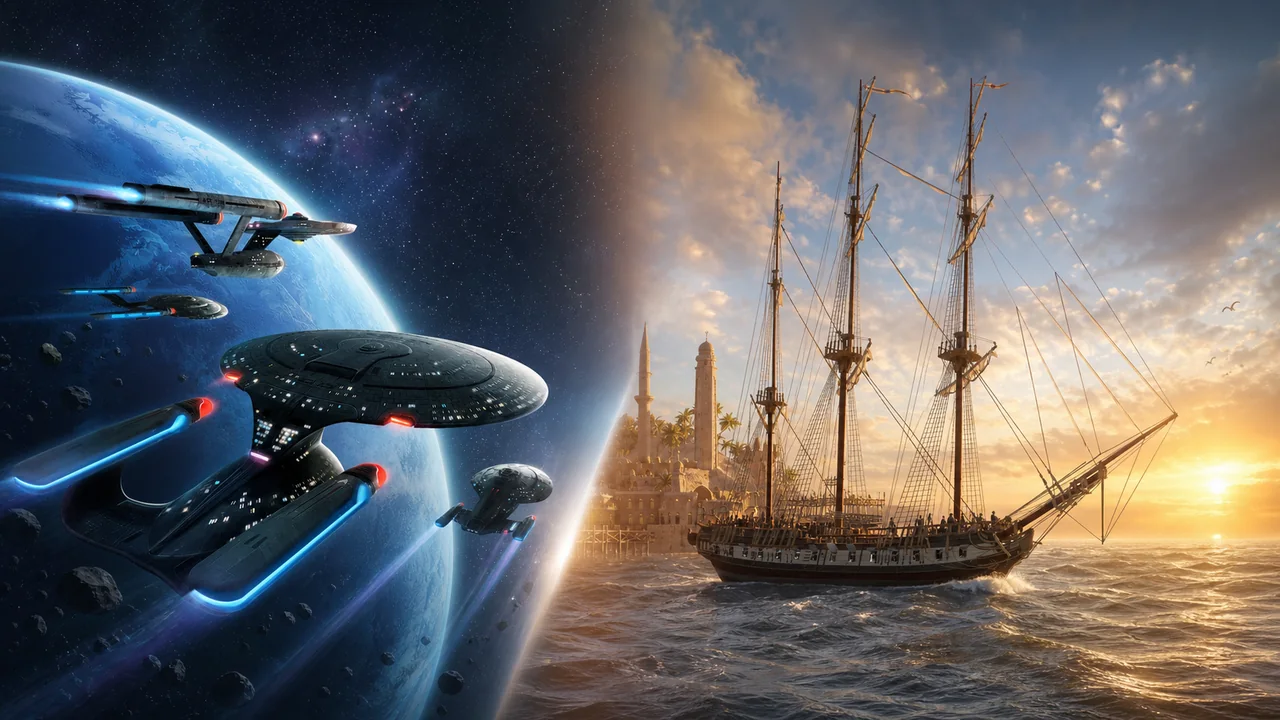
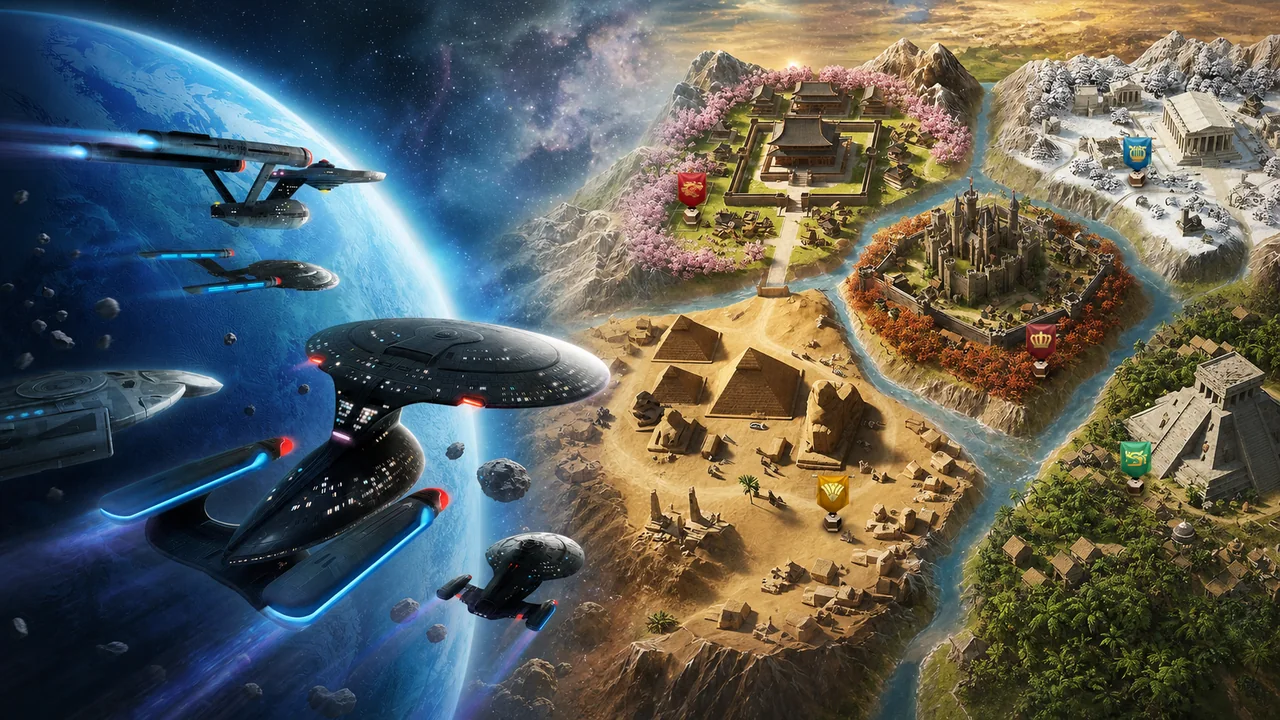
The short answer: pick Star Trek Fleet Command if you want recognizable officers and starships, a starbase to develop and one persistent account across Windows, Mac, iOS and Android. Pick World of Sea Battle if you want to steer a sailing ship directly, line up broadsides, trade in a player-driven economy and join territorial guild wars on Windows. They share fleets, guilds and free-to-play progression, but they are not substitutes: one is a collection-heavy 4X built around the Star Trek licence, while the other is an Early Access naval sandbox built around manual sailing.
This comparison uses Scopely's official site and M94.1 notes, Thera Interactive's official site and B20 notes, Apple's STFC listing and World of Sea Battle's Steam record, all checked on August 31, 2026. Those sources do not establish endgame account balance, a controlled cash-shop comparison or population by region.
Star Trek Fleet Command vs World of Sea Battle at a glance
|
Star Trek Fleet Command |
World of Sea Battle |
Better for you if… |
| Core fantasy |
Command iconic Star Trek ships and officers |
Captain historical sailing ships in an open archipelago |
You want a licence or a simulation-flavored sandbox |
| Genre on record |
Online open-world strategy / 4X RPG |
Open-world action MMO / RPG in Early Access |
You prefer account planning or direct control |
| What you control |
A starbase, multiple ships and officer crews |
One actively sailed ship, cargo, cannons and crew |
World of Sea Battle for hands-on navigation |
| Combat emphasis |
Crew setup, ship matchups and progression before an exchange |
Position, wind, ammunition, broadsides and disengagement |
World of Sea Battle for execution |
| Economy |
Refinery, research, events, resources and packs |
Player-supplied goods, trade routes, production and smuggling |
World of Sea Battle for a market career |
| Group layer |
Alliances, raids, armadas and shared events |
Guild privileges, port wars, politics and faction conflict |
Tie — both become better with a group |
| Official platforms |
Windows, macOS, iOS and Android |
Windows client and Steam |
STFC for cross-platform play |
| Development record checked |
M94.1 dated August 28, 2026 |
B20 dated July 10, 2026 |
Both actively updated |
| Store status |
Free with in-app purchases and loot boxes disclosed |
Free-to-play Early Access with in-app purchases |
Neither is a premium one-time purchase |
The comparison should not be read as “space ships versus old ships.” Star Trek Fleet Command asks how efficiently an account can unlock and combine systems over months. World of Sea Battle asks what a captain can do with a ship, route and group inside a risky world. A player can enjoy one and dislike the other despite loving naval games.
How we compared them
We evaluated the games on control model, progression, economy, social dependence, platform access and monetization evidence. Current publisher pages and patch notes establish features and update state. Apple and Steam establish platform and purchase disclosures. Our individual reviews provide an editorial fit judgment, not a substitute for a controlled late-game test.
Here, pay-to-win pressure means that spending can materially compress progression, widen competitive options or reduce recovery time. Risk means that a player's time or carried value can be lost through a bad voyage or defeat. Those are different pressures: one sells speed, while the other makes decisions consequential. Neither label alone proves that a game is fair.
Which game has better fleet combat?
World of Sea Battle has the more direct combat system on the available official record.
Thera Interactive's official overview describes sailing historical ships, selecting ammunition and fighting PvE or PvP encounters in an open world. The Steam page lists round shot, heated shot and chain shot, while ship class, cargo and route create reasons either to engage or escape. Its B20 update adjusted ship handling, collision behavior, protection and aimed-shot calculations. Those are the concerns of a game where steering and firing matter moment to moment.
Star Trek Fleet Command puts more of the decision before contact. Scopely's official page emphasizes collecting and upgrading starships, recruiting officers with tactical abilities and expanding a starbase to reach farther systems. A crew changes a ship's purpose; research and station development determine which ships and officers can contribute. Combat resolves the account-building plan rather than testing manual piloting.
That does not make STFC thoughtless. Crew synergy, target selection, repair cost and alliance timing matter. It means the satisfying question is “Did I build the right machine?” In World of Sea Battle, the satisfying question is closer to “Did I sail and fire that machine well?”
Which world is more interesting to live in?
Star Trek Fleet Command wins on recognizable fiction. Its official material spans familiar factions, officers and ships, from Federation explorers to Romulan and Klingon vessels. Missions and live arcs can draw from decades of Star Trek. If naming the Enterprise or assembling a crew of familiar characters is the reason to install, a generic naval sandbox cannot reproduce that value.
World of Sea Battle wins on economic identity. The official site says goods, weapons and ships on its market are supplied by players, with prices moving according to demand and war. Steam describes trading, production chains, fishing, raiding, a private island and territorial guild conflict. A captain can define progress through commerce or exploration rather than treating every ship as only a combat score.
B20 strengthened that social economy with guild privileges, revised port conflict, economy and smuggling work, new specialists and interface changes. It also limited maximum guild fleet size to 30 members. Those details make World of Sea Battle feel like a changing place, but they also underline that it is still in development.
How different is progression?
STFC is a layered account treadmill by design. The station gates research; research and level gates ships; officers alter ships; resources and repair time gate activity. Every layer can make another layer useful. That interdependence produces long-term goals and also a severe onboarding wall.
World of Sea Battle is closer to a career. A player can learn a trade route, improve a ship, specialize in combat or commerce and join a guild whose territorial goals give the next voyage a purpose. The Steam record describes dozens of customizable ships and a current world with city conquests, PvE modes, faction wars, open-sea raids and seasonal activity.
Its progression is not frictionless. Travel consumes real time, a bad route can expose cargo, and a larger ship increases what is at stake. B20's specialist system even includes timed searches, so direct sailing does not mean the game has no waiting mechanics. The difference is that World of Sea Battle more often asks the player to be present for the journey; STFC more often asks the player to manage simultaneous account queues.
Read our Star Trek Fleet Command review for the full account-progression assessment, and our World of Sea Battle review for the sailing, trade and guild risk in more detail.
Can you play both on PC and mobile?
Star Trek Fleet Command has the decisive platform advantage. Scopely's official site exposes Windows, Mac, iOS and Android downloads, and the account can be connected through Scopely's system. It is built for short mobile check-ins as well as a larger desktop view.
World of Sea Battle is a Windows game. Its official site offers a client, and Steam lists a 64-bit Windows requirement, online PvP, online co-op and a required World of Sea Battle account that can link to Steam. No official mobile or macOS client is listed in the records checked for this comparison.
That difference should decide the comparison immediately for some readers. If you need to repair, collect and coordinate from a phone during the day, STFC is the practical option. If you want a game that expects keyboard-and-mouse attention while sailing, World of Sea Battle's narrower platform support is consistent with its design.
Use the official client or Steam route for World of Sea Battle, and Scopely's official download page for STFC. Our guide to playing STFC on PC or Mac covers the account-linking route. In either game, confirm the correct account and server before spending or assuming progress is missing.
Which game handles monetization better?
The official records support caution, not a clean winner.
Apple lists Star Trek Fleet Command as free with in-app purchases and discloses loot boxes. The visible examples include low-cost offers and packs at $99.99, but those are storefront examples rather than a total cost. The underlying 4X economy ties competitive options to station, research, officers, ships, resources and time, so spending can compress several constraints at once.
Steam lists World of Sea Battle as free-to-play Early Access with in-app purchases, and its content disclosures include randomized in-game purchases. The developer says the game will remain free after Early Access. That confirms a live-service purchase layer; it does not, by itself, prove how much competitive power each purchase buys.
World of Sea Battle may feel less aggressively monetized to a player focused on trading and sailing because execution and route knowledge are visible. Do not turn that feeling into an unsupported promise. The game has purchasable systems, an evolving economy and material risk. STFC is more clearly built around recurring account acceleration, but the responsible recommendation is to set a budget in either game and refuse to spend merely to recover status.
Which is better for solo players and guilds?
World of Sea Battle offers more meaningful solo activities. A trader can study routes, a captain can fish or explore, and PvE gives a ship something to do without assembling a large fleet. The official Steam copy still warns that solo sailing is risky and points players toward crews and guilds for larger battles and politics.
STFC offers many solo tasks — mining, missions, research and ship development — but alliances make the larger economy work. Scopely presents alliances as sources of assistance, battle, raids and community. Armadas and scheduled events convert a personal collection into shared progress.
Neither is a single-player campaign. World of Sea Battle gives a solitary captain more agency during a session; STFC gives a solitary collector more queues. For long-term play, choose a group whose language, time zone and risk tolerance fit you.
Who should pick which?
| If you… |
Pick |
Why |
| Want recognizable Star Trek officers and ships |
Star Trek Fleet Command |
The licence is integrated into crews, factions, missions and live arcs |
| Want to steer and fire a ship yourself |
World of Sea Battle |
Wind, approach, ammunition and broadsides shape direct combat |
| Need phone, Mac and Windows access |
Star Trek Fleet Command |
Scopely lists all four major routes |
| Want trading to be a career |
World of Sea Battle |
Player-supplied markets and production routes give cargo a purpose |
| Enjoy long collection and upgrade plans |
Star Trek Fleet Command |
Officers, ships, station and research form the deeper account machine |
| Want a finished, stable ruleset |
Neither without a caveat |
STFC changes through live arcs; World of Sea Battle is explicitly Early Access |
| Want a one-time premium purchase |
Neither |
Both are free-to-play with in-app purchases |
| Want to play completely alone |
Neither |
Alliances or guilds unlock the most consequential activity |
What we did not compare
We did not compare regional player populations, because a current global total says little about activity in one time zone and neither publisher provides comparable audited data. We did not calculate the value of individual packs or randomized items. We did not claim manual combat cancels account power. And we did not score future World of Sea Battle roadmap items as if they were already complete.
Frequently asked questions
Is World of Sea Battle a naval version of Star Trek Fleet Command?
No. STFC is a multi-platform 4X and collection RPG where station, ships and officers determine most combat outcomes. World of Sea Battle is a Windows open-world MMO where the player sails, aims, trades and carries risk directly.
Which game has more skill-based combat?
World of Sea Battle. Its official systems emphasize steering, ammunition, approach and open-world engagements. STFC still rewards crew construction and target knowledge, but it tests preparation more than real-time piloting.
Can I play World of Sea Battle on mobile or Mac?
No official mobile or macOS client appears in the publisher and Steam records checked on August 31, 2026. World of Sea Battle lists Windows. STFC officially supports Windows, macOS, iOS and Android.
Is World of Sea Battle less pay-to-win than STFC?
The evidence is not strong enough for a guarantee. STFC visibly sells progression acceleration across a layered 4X account. World of Sea Battle is free-to-play with in-app and randomized-purchase disclosures, while skill and trade remain important. Treat both as games where purchases can affect progression.
Do I need a guild or alliance?
Yes for the richest long-term play. STFC alliances support armadas, events and assistance. World of Sea Battle guilds pursue privileges, ports and territorial politics. Both allow solo tasks, but neither reaches its full design as an isolated game.
The verdict
Pick Star Trek Fleet Command if the licence, collection and accessibility are the product for you. It offers familiar officers and ships, an unusually deep upgrade machine and official access from phone, Windows or Mac. Accept that progress is timer-driven and that its store can convert money into speed and options.
Pick World of Sea Battle if you want the voyage itself to matter. Steering, trade routes, cargo, ammunition and guild territory give decisions physical consequences that STFC's largely prepared combat cannot match. Accept Windows-only access, Early Access change and an economy where a bad trip can cost time and value.
There is no universal fleet champion here. World of Sea Battle wins for direct naval play; Star Trek Fleet Command wins for cross-platform collection and Star Trek fantasy. For a neutral Windows player who cares more about controlling one ship than unlocking famous ones, World of Sea Battle is the more distinctive install. For everyone already imagining Kirk, Spock or the Enterprise, STFC wins before the first battle begins.
For another look at STFC against a mature alliance 4X, read Star Trek Fleet Command vs Rise of Kingdoms. If the mobile pirate side of the genre interests you, our Sea of Conquest review provides the closest thematic alternative.
Free to play. Standard data rates and in-app purchases apply.