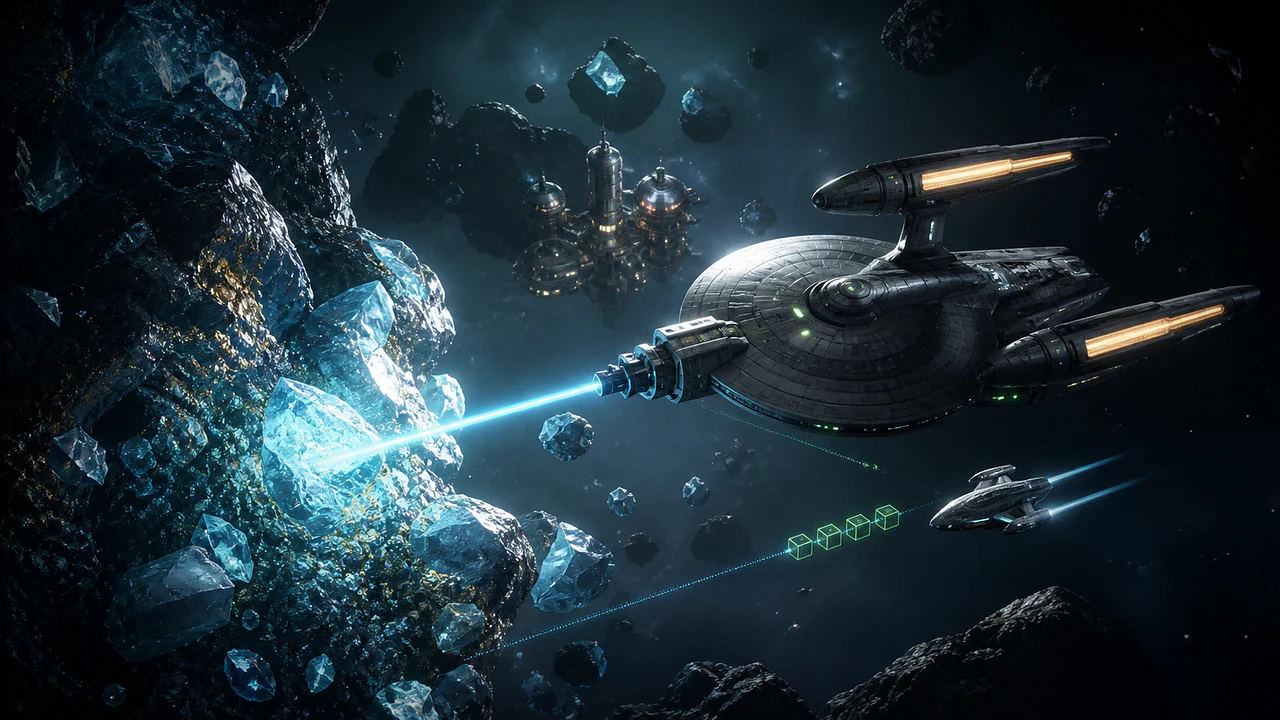
The short answer: prioritize the Star Trek Fleet Command ship built for the job you repeat. Put a correctly matched combat ship first for hostiles and PvP, a Survey ship first for mining and cargo, then one faction ship you can afford to crew and tier. The USS Enterprise, Augur and Saladin are recognizable long-term targets, but none is a universal answer for a new station. A focused, adequately tiered ship with the right crew is more useful than a famous hull left starved of parts.
This priority framework is deliberately role-based. STFC changes through live updates, account levels and specialty loops, while blueprint access and faction reputation differ between players. Scopely's official Ships Guide establishes the durable rules: combat ships belong to a class triangle, Survey ships trade combat strength for mining and cargo utility, and every new hull still needs blueprints, research, Shipyard access, components and a drydock. Those constraints matter more than a raw power screenshot.
STFC ship role priorities at a glance
| Priority |
Ship role |
Best use |
Why it belongs here |
Main warning |
| 1 |
Correct combat-class ship for the target |
Hostiles, PvP and general combat |
Class advantage and a coherent crew improve repeatable wins |
The best class changes with the opponent |
| 2 |
Survey ship matched to the resource |
Mining and protected cargo |
Purpose-built mining bonuses and cargo capacity save active time |
Weak in ordinary combat |
| 3 |
One developed faction combat ship |
Mid- and late-game progression |
Concentrated blueprints, parts and officers produce a dependable flagship |
Spreading across factions delays useful tiers |
| 4 |
Specialty ship for a loop you actually play |
Armadas, events or special resources |
A specialized ability can outperform generic power inside its activity |
Poor value if the activity is ignored |
| 5 |
Cheap utility or backup ship |
Low-risk errands and secondary drydocks |
Keeps the flagship free and lowers repair exposure |
Do not over-invest in a temporary hull |
The table does not claim that every Survey ship is better than every combat ship. It prioritizes account jobs. When the task changes, the order changes. That is why our detailed ships and mining guide separates miners from combat progression instead of forcing them into one power list.
1. The best combat ship is the class that counters your target
STFC's combat triangle is the first filter, not an optional detail. Scopely groups ordinary combat hulls as Interceptors, Explorers and Battleships and says choosing the correct type grants an advantage. Before comparing two power numbers, inspect the target class and bring the side of the triangle designed to beat it. A lower-looking ship can be the better assignment when its class, research and crew line up.
This makes a flexible combat roster more valuable than one permanently crowned “best ship.” Interceptors are fast, Explorers often reward shield-oriented builds, and Battleships lean into hull durability and heavy attacks, but officers and ship abilities can change how those identities play. The practical ranking is therefore:
- A counter-class ship you can repair repeatedly.
- A same-class flagship with a specialized crew when the target mechanic demands it.
- A higher-power mismatch only when research and crew advantages clearly overcome the class disadvantage.
The official fleet page identifies the Saladin as an Interceptor, the Enterprise as an Explorer, and the Augur and Bortas as Battleships. Those names are useful examples of distinct paths, not proof that one faction wins every encounter.
2. Survey ships are the best ships for mining and cargo
Survey ships rank second overall because resource work is not a side activity in a persistent 4X. Scopely explicitly describes them as ships made for mining and carrying resources, while warning that they are not particularly good at combat. That clarity should guide investment: a Survey ship earns its place by shortening mining time, reaching a node and protecting more of the trip's value, not by defeating a combat flagship.
Choose a Survey ship around three questions:
- Does its ability improve the resource you currently need?
- Is its protected cargo enough for the time you plan to remain on a node?
- Can its warp range reach the systems your account now uses?
A miner that reaches the correct resource and returns with protected cargo is better than a nominally stronger miner stuck in the wrong systems. Avoid using a Survey ship to test PvP unless an event or specific mechanic requires it. The repair and cargo risk usually defeats the purpose of sending it out.
3. One developed faction ship beats three unfinished projects
The third priority is not a specific faction; it is focus. Federation, Klingon and Romulan progression can each produce strong hulls, but blueprints, faction credits, uncommon and rare parts, ship XP and officers compete for attention. A player who begins three expensive builds at once often owns more hulls but fewer ships capable of clearing the content that matters.
Scopely's faction ship showcase provides concrete examples. The Enterprise is an Explorer whose published ability heals shield health while Morale is active. The Augur is a Battleship with an ability connected to Burning. The Bortas is a Battleship whose listed ability supports station defense. These descriptions prove why crew state and assignment matter: a ship ability is only as useful as the situation that activates it.
Choose the faction line that fits the officers and reputation you are already developing. Then set a stop point before spending. Build the hull, reach the component tier that clears your current hostiles or event bracket, and reassess. The account does not benefit when every available component disappears into a ship whose next useful target remains several Ops levels away.
4. Specialty ships win only inside the activity they were designed for
Specialty ships take the fourth priority because their ceiling can be enormous and their general value can be narrow. STFC contains loops with their own targets, currencies, research and crews. A ship built for one of those loops may outperform a much larger generic combat hull there, yet contribute little to the daily tasks a different player prefers.
Use this test before chasing a specialty blueprint:
| Question |
A good reason to build |
A reason to wait |
| Do you play the activity every week? |
The loop is part of your normal routine |
You only open it during a rare event |
| Can you source blueprints predictably? |
Currency and milestones are understood |
Progress depends on an unknown future offer |
| Do you have the required crew? |
Officers already support the mechanic |
The hull would launch without its key synergy |
| Does it unlock a bottleneck? |
It reaches a resource, target or reward you need |
It duplicates a ship that already clears the content |
Update 94.1 shows why this category must remain dated: Scopely's current patch notes adjust sourcing, activities and quality-of-life systems while the wider ship economy continues to evolve. Re-check the current event and sourcing screen before committing paid currency or rare materials.
5. Cheap utility ships are better than using a flagship for every errand
A backup ship takes the fifth priority because drydocks are parallel work slots. Scopely explains that each drydock holds one assigned ship and that a hull must return home before it can be swapped. If the only capable vessel is always traveling, repairing or tiering, every other task waits.
Keep one inexpensive hull for low-risk missions, map discovery or routine travel when the flagship is busy. The utility ship does not need maximum components. It needs enough warp, cargo or combat power for its assignment and a repair cost that does not punish ordinary use. This is also a sensible place for a ship you are about to replace: stop at the tier that completes the job, then redirect parts toward the next real milestone.
The same rule applies to hangar space. Scopely notes that Operations 20 unlocks the Scrapyard and that some ships cannot be scrapped by default. Do not build every available hull simply because blueprints are complete. Each extra project creates another invitation to spend parts and Ship XP.
How to choose a ship without wasting materials
Write the assignment before opening the upgrade screen. “I need a stronger ship” is too vague. “I need to defeat level-X Explorer hostiles with fewer repairs” or “I need enough protected cargo for a 45-minute mining session” creates a testable target.
Then follow this checklist:
- Identify the repeated target, resource or event.
- Choose the class or specialty ability that addresses it.
- Confirm blueprints, Shipyard level, research and drydock availability.
- Build a crew for that target using our officer and crew guide.
- Upgrade only until the assignment becomes reliable.
- Record the next bottleneck before spending more parts.
Ship XP alone is not the whole upgrade. Scopely's guide says individual components must be upgraded before a tier increase, and the ship remains unavailable during tiering. Start long tiers when that drydock will not be needed for an event or alliance plan.
Which famous ship should be your long-term target?
For a Federation-focused account, the USS Enterprise is an understandable long-term target because its official ability interacts with Morale and shield healing. For a Romulan account built around Burning, the Augur has a published ability that rewards that state. For Klingon or station-defense priorities, the Bortas has a clearly documented defensive role. The Saladin represents the Interceptor route and remains a useful example of why class diversity matters.
These are not starter recommendations. Their value depends on faction reputation, blueprint access, officers and the content available to the account. Read our STFC beginner guide before treating an endgame showcase as an early build order. A new player should first learn the combat triangle, keep research current and develop a repairable workhorse.
Spending and upgrade traps to avoid
The easiest mistake is buying progress toward a ship without pricing the rest of the build. Blueprints create the hull; they do not supply every component, officer, research node or repair resource needed afterward. Before using money or premium currency, inspect the entire path visible to the account.
Avoid these traps:
- Buying the last blueprints for a ship that the Shipyard cannot build yet.
- Tiering several combat classes evenly when only one clears current content.
- Sending a Survey ship into avoidable combat with unprotected cargo.
- Copying a crew without checking whether the ship ability requires Morale, Burning or another state.
- Upgrading past the point where the ship already performs its defined job.
Our 2026 STFC review explains the wider progression and spending pressure. Test the ordinary sourcing route before paying to accelerate it.
Frequently asked questions
What is the single best ship in Star Trek Fleet Command?
There is no universal winner. Use the correct combat class for the target, a Survey ship for mining, and a specialty ship only for its intended loop. Crew, research, tier and repair sustainability can matter more than the hull name.
Are Survey ships worth upgrading?
Yes, when mining time, warp reach or protected cargo is the account bottleneck. Stop when the ship reliably reaches and returns from the resource systems you use; do not upgrade it as if it were a general combat flagship.
Is the Enterprise better than the Augur?
They serve different class, faction and ability plans. The Enterprise is an Explorer with a published Morale-linked shield ability; the Augur is a Battleship with a Burning-linked damage ability. The better choice is the one supported by your faction reputation and officers.
Should a beginner build every ship that becomes available?
No. Build for a defined job and protect scarce parts. Hangar space, drydocks, blueprints and components are constraints, and Operations 20 later adds the Scrapyard for eligible ships.
Does a higher power number always win?
No. The combat triangle, research, officers, ship ability and target mechanics can overturn a simple power comparison. Power is a screening number, not a complete battle forecast.
Final role-priority verdict
For most accounts, the winning order is counter-class combat ship, resource-matched Survey ship, one focused faction flagship, one proven specialty ship, then a cheap utility hull. This structure covers the jobs STFC repeatedly asks the account to perform without pretending that one expensive ship can replace an entire roster.
If you play on desktop while planning those upgrades, our official PC and Mac guide explains how to move the same Scopely Account safely. Build fewer ships, give each a job and let completed assignments—not collection pressure—decide the next investment.
Free to play. Standard data rates and in-app purchases apply.